

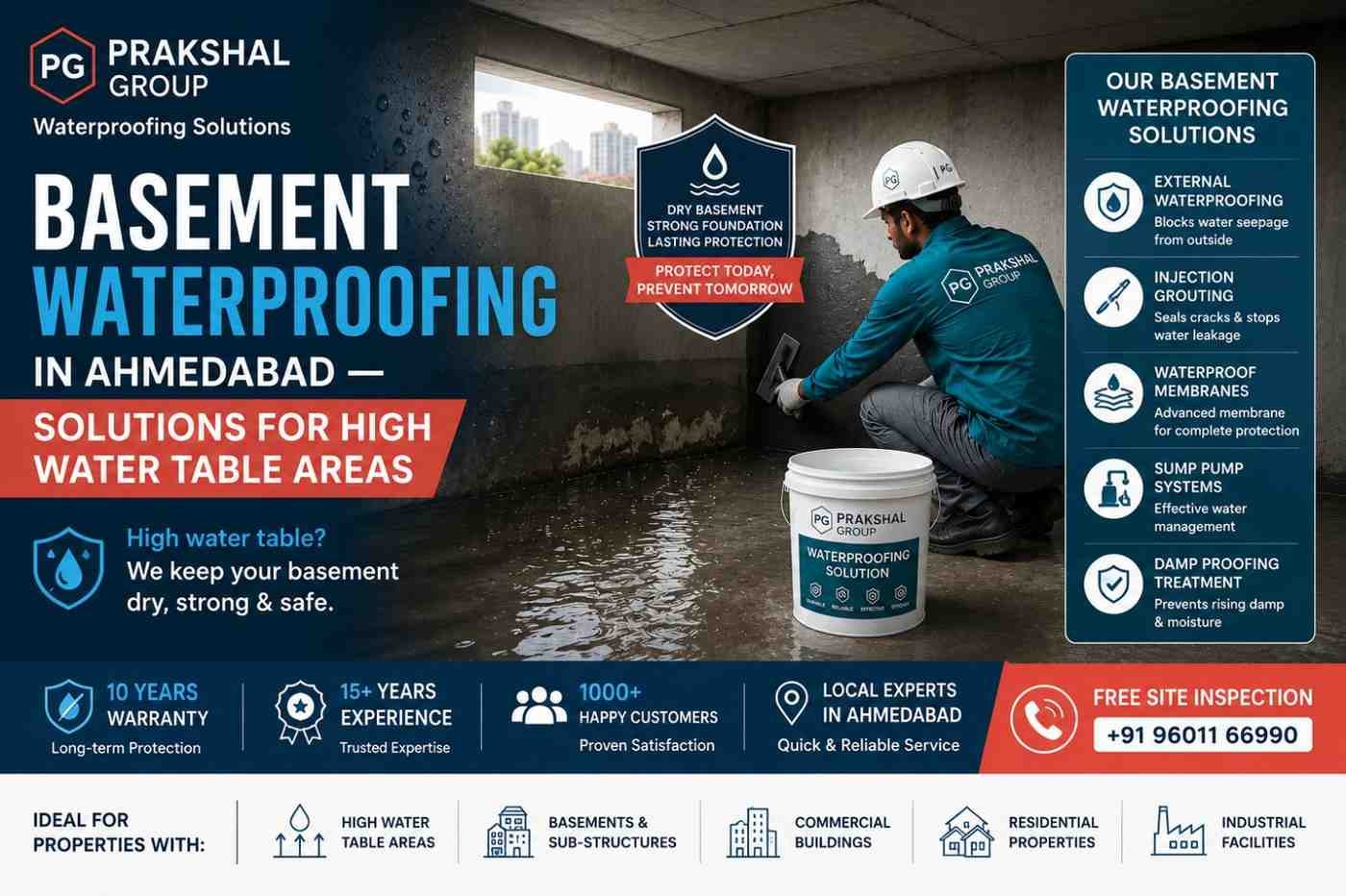

Basement waterproofing in Ahmedabad presents unique challenges. The city has areas with relatively high groundwater tables — particularly in low-lying localities and areas near rivers and lakes. During monsoon, groundwater levels rise further, putting significant hydrostatic pressure on basement walls and floors. If your basement is not properly waterproofed, water will find its way in.
Why Basement Waterproofing in Ahmedabad Is Different
Unlike terrace waterproofing where water flows downward, basement waterproofing must resist water coming from the ground in all directions — sides, floor, and even upward (negative-side pressure). This is called hydrostatic pressure, and it increases with water table depth and monsoon rainfall.
In Ahmedabad, areas such as parts of Narol, Vatva, areas near the Sabarmati riverfront, and various low-lying localities see significant groundwater rise during monsoon. Basements in these areas without proper waterproofing will experience seepage or active leakage every year.
Types of Basement Waterproofing Systems
1. Exterior (Positive Side) Waterproofing
Applied on the outside of the basement walls, this system prevents water from ever reaching the structure. It is the most effective approach but requires excavation around the building.
Best for: New construction or buildings undergoing major renovation where excavation is feasible.
Materials used: Polymer-modified membranes, torch-applied APP/SBS membranes, crystalline coatings on exterior concrete.
2. Interior (Negative Side) Waterproofing
Applied on the inside of basement walls and floor, this system accepts that water will reach the structure but prevents it from entering the interior space. It works against hydrostatic pressure from the outside.
Best for: Existing buildings where exterior excavation is not practical.
Materials used: Crystalline waterproofing compounds, cementitious coatings, injection grouting.
3. Drainage System (Cavity Drain)
A cavity drainage system uses a dimple membrane on the interior walls with a perimeter drainage channel and sump pump. Water is allowed to reach the cavity, collected, and pumped out.
Best for: Very high water table areas or when positive and negative side treatments are insufficient alone.
4. Injection Grouting
For active water leaks through cracks, polyurethane or epoxy injection stops water ingress immediately by expanding inside the crack and sealing it.
Best for: Emergency situations with active water flow through cracks.
Step-by-Step Basement Waterproofing Process
- Thorough inspection of the basement — mapping all seepage points, cracks, and high-humidity areas
- Identification of water table level and seasonal variation
- Selection of appropriate waterproofing system
- Surface preparation — cleaning, crack routing, dust removal
- Application of waterproofing treatment — walls, floor, and wall-floor junction
- Sealing all construction joints and pipe penetrations
- Application of protection layer
- Final inspection and water test
Basement Waterproofing Cost in Ahmedabad
| Treatment Type | Approximate Cost |
| Interior cementitious waterproofing | ₹60–₹100 per sq. ft. |
| Crystalline negative-side treatment | ₹80–₹130 per sq. ft. |
| Injection grouting (active cracks) | ₹500–₹2,000 per injection point |
| Full cavity drain system with sump | ₹150–₹300 per sq. ft. |
Signs Your Basement Needs Waterproofing
- Visible water seepage or wet patches on walls
- Efflorescence (white salt deposits) on concrete walls
- Mould or mildew growth
- Musty smell that does not go away
- Damp or wet floor during and after monsoon
- Rusting of any metal elements (pipes, shelving, electrical conduits)
Frequently Asked Questions
Can a basement be waterproofed from the inside?
Yes. Interior (negative side) waterproofing is a well-established approach and is the most common solution for existing buildings in Ahmedabad where excavation is not practical.
How long does basement waterproofing last?
A professionally applied interior crystalline or cementitious system typically lasts 10 to 15 years. Exterior membrane systems last 10 to 20 years depending on soil conditions.
Is basement waterproofing possible during monsoon?
Active leak injection grouting can be done during monsoon as an emergency measure. Full waterproofing treatment is best done in dry conditions.
What is the most common cause of basement leakage in Ahmedabad?
Construction joints between the floor slab and walls, and around pipe penetrations, are the most common entry points for water in Ahmedabad basements.
Protect Your Basement Before the Monsoon Arrives
📞 Call us: 96011 66990 🌐 Visit: prakshalgroup.com 📍 Om Tower, Ahmedabad
Prakshal Group — Basement Waterproofing Experts in Ahmedabad | Free Inspection | 10-Year Warranty