



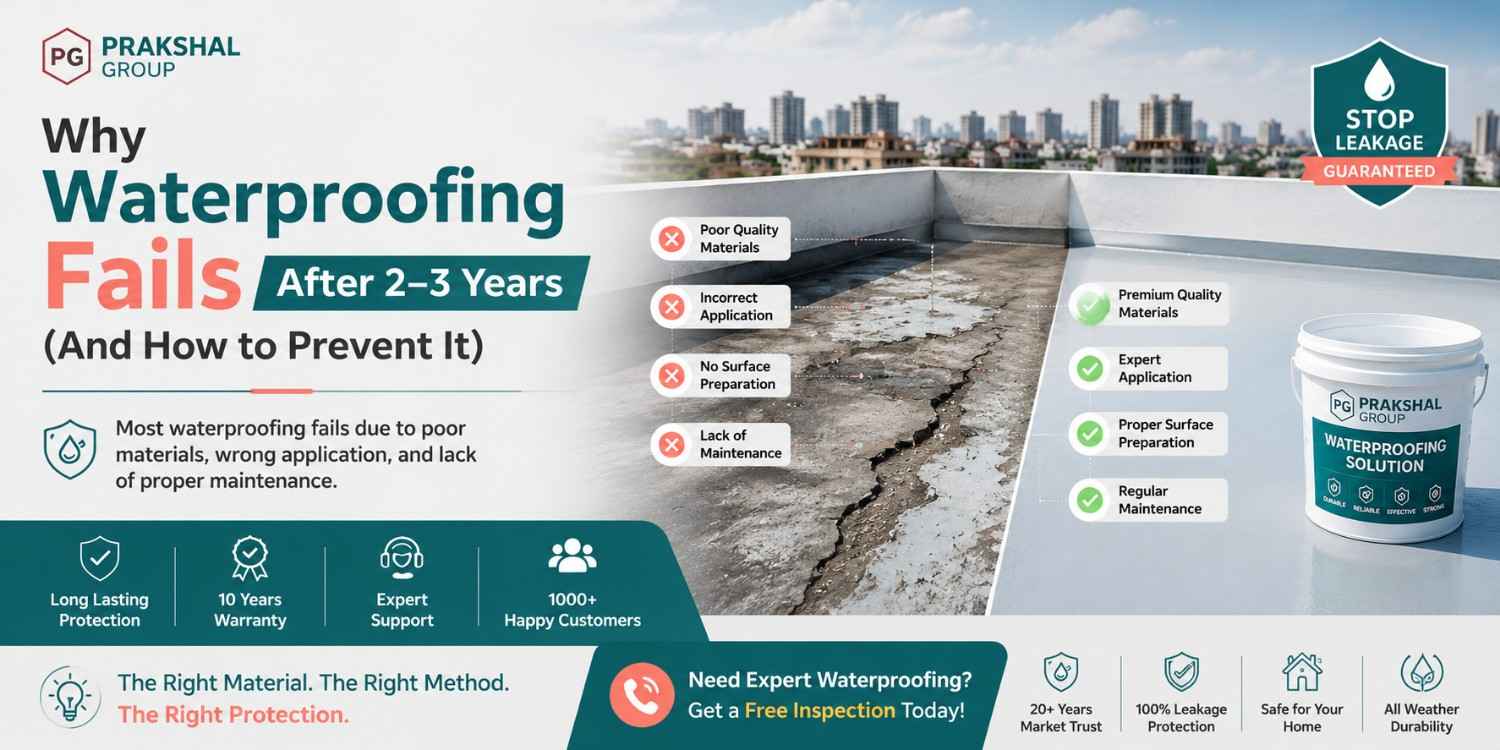

Waterproofing fails after 2 to 3 years primarily due to poor surface preparation, use of low-quality materials, incorrect application technique, failure to seal joints and penetrations, and absence of a UV-protective top coat. Even the best waterproofing material will fail quickly if the surface beneath it is not correctly cleaned, primed, and prepared before application. Choosing experienced waterproofing contractors in Ahmedabad who follow a proper process and use genuine branded materials is the single most effective way to prevent early waterproofing failure.
The Problem Every Ahmedabad Homeowner Knows Too Well
You get your terrace waterproofed. The contractor assures you it will last for years. One or two monsoons later — the ceiling is damp again, the paint is peeling, and the leakage is back.
Sound familiar?
This is one of the most common complaints we hear at Prakshal Group. Homeowners across Ahmedabad spend money on waterproofing — sometimes repeatedly — only for it to fail within 2 to 3 years. The frustration is completely valid. But the problem is almost never the concept of waterproofing itself. It is how it was done.
Understanding why waterproofing fails is the first step to making sure your next treatment actually lasts — and lasts for 10 years or more.
8 Real Reasons Why Waterproofing Fails After 2–3 Years
1. No Proper Surface Preparation — The Number One Cause
This is responsible for more than half of all early waterproofing failures in Ahmedabad. No matter how good the material is, it cannot bond to a dirty, dusty, painted, or damp surface.
Professional surface preparation involves:
- Mechanically grinding or scraping off all old paint, coatings, and loose material
- Removing all dust with industrial vacuum or blower
- Routing all cracks before filling — widening them slightly so filler penetrates and bonds properly
- Applying the correct primer and allowing full drying time
- Ensuring the surface is 100% dry before any membrane is applied
What most cheap waterproofing contractors in Ahmedabad actually do: sweep the surface, apply a thin coat, and call it done. The result is a coating that sits loosely on top of the surface rather than bonding to it — and peels or cracks within one or two monsoons.
How to prevent it: Before work begins, ask your contractor specifically what surface preparation steps they will follow. If they cannot describe the process in detail, or say they will start applying material on the same day as inspection, walk away.
2. Wrong or Low-Quality Materials
Not all waterproofing materials are equal — and this difference becomes visible within 2 to 3 years.
Common shortcuts taken by low-cost waterproofing contractors in Ahmedabad:
- Using unbranded or duplicate waterproofing compounds
- Diluting branded materials to stretch coverage and increase margins
- Using a basic acrylic paint marketed as “waterproofing” rather than a genuine membrane system
- Using rigid materials in areas that need flexible treatment (parapet joints, cracks)
Ahmedabad’s climate — with temperatures exceeding 42°C in summer and heavy monsoon rainfall — is particularly demanding. Standard-grade materials degrade much faster here than their rated lifespan suggests. Only materials specifically rated for UV resistance and thermal movement will perform reliably.
How to prevent it: Ask your contractor to name the specific product and brand they will use — and ask to see the product packaging on site. Reliable waterproofing contractors in Ahmedabad will always use materials from brands like Dr. Fixit (Pidilite), Fosroc, Sika, or BASF, and will be transparent about it.
3. Coating Applied Too Thin
Every waterproofing membrane has a minimum required dry film thickness — typically 1 to 2mm for most systems. This thickness is what gives the membrane its water resistance and durability.
Achieving the required thickness means applying multiple coats — usually two to three. Each coat takes time to dry before the next can be applied. Cheap contractors cut this time and cost by applying a single thin coat or by applying second coats before the first has cured — which prevents proper bonding between layers.
A membrane applied at half the required thickness will have a fraction of the rated durability. What was designed to last 10 years may fail in 2 to 3.
How to prevent it: Ask how many coats will be applied and what the target dry film thickness is. A contractor who cannot answer this question specifically is not applying the material to specifications.
4. Joints and Penetrations Left Unprotected
This is where the majority of waterproofing failures actually begin—even when the main surface was done reasonably well.
Critical points that every professional waterproofing job must treat individually:
- Parapet wall junction (where terrace floor meets parapet wall)
- All pipe and cable penetrations through the slab
- Drain outlets and drain lips
- Expansion joints and construction joints
- Corners and angle changes
These areas experience far more movement than the flat slab surface. They need flexible sealant, fibre mesh reinforcement, and extra waterproofing membrane—not just the same coating applied uniformly across the surface.
When these joints are not treated correctly, water finds them almost immediately. The main surface may still be intact, but leakage returns through the untreated joints—making it appear as though the waterproofing has “failed” everywhere.
How to prevent it: Specifically ask your contractor how parapet wall joints and pipe penetrations will be treated. The answer should include flexible sealant, backing rod, fiber mesh, and additional membrane layers at these points.
5. No UV Protection on Exposed Surfaces
Many waterproofing membranes — particularly bituminous and some acrylic systems — are not designed for direct, long-term UV exposure. In Ahmedabad, where the sun is intense for 8 to 10 months of the year, an unprotected membrane degrades significantly faster than its rated lifespan.
Bituminous membranes left exposed without a protective screed or UV-resistant top coat can begin to crack and lose flexibility within 2 to 3 years — exactly the timeline most homeowners report when waterproofing “fails.”
How to prevent it: Ensure your waterproofing system includes either a UV-protective top coat (for liquid-applied systems) or a protective cement screed (for membrane systems). Never leave a bituminous membrane exposed to direct sun.
6. Waterproofing Applied in Wrong Weather Conditions
Temperature and humidity have a significant impact on how waterproofing materials cure and bond. Most waterproofing materials should be applied:
- On dry surfaces — moisture from recent rain or dew prevents bonding
- In temperatures between 10°C and 40°C
- Not in direct peak afternoon sun (surface temperatures can exceed 60°C in Ahmedabad summer, causing rapid drying that prevents proper curing)
- Not during active rain or high humidity (above 85% relative humidity)
Some contractors in Ahmedabad apply waterproofing during monsoon on damp surfaces simply because the client is urgently asking for it. The result is predictably poor — the membrane bonds weakly, traps moisture, and fails quickly.
How to prevent it: Schedule waterproofing for March to May (pre-monsoon) or October to January (post-monsoon) for best results. These windows provide ideal temperature and humidity conditions for professional-grade waterproofing in Ahmedabad.
7. Drainage Problems Left Uncorrected
A waterproofing membrane is not designed to permanently hold standing water. If your terrace has poor drainage — either because the slope is insufficient or because drain outlets are blocked — water pools on the surface and puts continuous hydrostatic pressure on the membrane.
Even a high-quality membrane will eventually fail under constant standing water pressure, especially when that water heats up and expands in Ahmedabad’s summer temperatures.
How to prevent it: Before waterproofing is applied, ensure all drains are clear and free-flowing, and that the terrace slope is correct — a minimum of 1:100 gradient toward drainage points. If the slope is inadequate, a new screed layer should be applied to correct it before waterproofing.
8. Choosing the Wrong Waterproofing Contractor in Ahmedabad
All of the above problems come down to one root cause: choosing a contractor based on the lowest price rather than demonstrated quality and experience.
In Ahmedabad’s competitive waterproofing market, it is easy to find contractors offering very low rates. The difference between a ₹25 per sq. ft. job and a ₹100 per sq. ft. job is not just price — it is the entire process: time spent on surface preparation, quality of materials used, number of coats applied, attention to joint treatment, and post-job testing.
Experienced, professional waterproofing contractors in Ahmedabad cost more upfront — but they save you money over 10 years by doing the job once, correctly, with a warranty.
How to prevent it: Choose waterproofing contractors in Ahmedabad who:
- Conduct a free physical site inspection before quoting
- Specify materials and brands in writing
- Provide a detailed written warranty (minimum 5 years, ideally 10 years)
- Have a verifiable portfolio of completed projects
- Have been operating in Ahmedabad for at least 5 years
How Long Should Quality Waterproofing Actually Last?
When done correctly by professional waterproofing contractors in Ahmedabad, here is what you should expect:
| Waterproofing System | Expected Lifespan (Professional Application) |
| Polymer-modified acrylic coating | 5–7 years |
| Crystalline waterproofing | 10–15+ years |
| PU (polyurethane) membrane | 10–15 years |
| APP/SBS torch-on membrane (with screed) | 12–20 years |
| Cheap cement + waterproofing compound | 1–3 years |
Prakshal Group’s waterproofing systems are backed by a written 10-year warranty — which is only possible because we use the right materials, follow the correct process, and do not take shortcuts.
What to Do If Your Waterproofing Has Already Failed
If your waterproofing has failed within 2 to 3 years, here is what to do:
Step 1 — Do not apply another coating on top of the failed one. Applying new waterproofing over failed, debonded material will fail just as quickly. The failed material must be removed first.
Step 2 — Get a professional inspection. An experienced waterproofing contractor in Ahmedabad will identify whether the failure is due to material, application, joint treatment, drainage, or a combination. Understanding the cause prevents repeating the same mistake.
Step 3 — Remove all failed coating mechanically. The surface must be taken back to bare concrete before reapplication. This adds cost but is non-negotiable for a permanent result.
Step 4 — Choose the right system for your specific situation. After understanding why the previous treatment failed, select a system specifically suited to your terrace’s conditions — not just whatever the next contractor quotes.
Step 5 — Get a written warranty. No professional waterproofing contractor in Ahmedabad should hesitate to provide a written warranty. If they will not, that tells you everything you need to know.
Why Ahmedabad Homeowners Trust Prakshal Group
Prakshal Group has been one of Ahmedabad’s most trusted waterproofing contractors for over 20 years. We have fixed hundreds of failed waterproofing jobs done by others — and we know exactly why they failed.
Our commitment is simple: we do not take shortcuts. Every project includes thorough surface preparation, genuine branded materials, correct application thickness, proper joint sealing, and a water ponding test before completion.
That is why we offer a written 10-year warranty on all our waterproofing work — and why 1000+ homeowners, housing societies, hospitals, and commercial buildings across Ahmedabad trust us.
Clients who trust Prakshal Group: IIM Ahmedabad · Maruti Suzuki Hospital · L&T Hydrocarbon · SMVS Swaminarayan Mandir · PSP Projects · Intas Pharma · Zydus Wellness · Arfin India
Frequently Asked Questions — Why Waterproofing Fails
Q: Why does waterproofing fail after just 2 years? A: Waterproofing fails after 2 years primarily due to poor surface preparation, use of substandard materials, insufficient coating thickness, and failure to seal critical joints and penetrations. These are shortcuts commonly taken by low-cost contractors. Professional waterproofing contractors in Ahmedabad who follow the correct process can deliver results that last 10 years or more.
Q: Can waterproofing be fixed if it has already failed? A: Yes, but the failed coating must be completely removed before reapplication. Applying new waterproofing over failed material will produce the same poor result. The surface must be taken back to bare concrete, properly prepared, and a new system applied correctly.
Q: How do I know if my waterproofing contractor in Ahmedabad is doing the job correctly? A: Key signs of a professional job: they conduct a site inspection before quoting, they prepare the surface before applying any material (grinding, crack filling, priming), they specify branded materials in writing, they apply multiple coats, and they provide a written warranty of at least 5 to 10 years.
Q: Why does waterproofing fail at joints even when the surface looks fine? A: Parapet wall joints, pipe penetrations, and drain outlets experience far more thermal movement than the flat surface. If these joints are not individually treated with flexible sealant and fibre mesh reinforcement, water enters through them regardless of how well the main surface is coated.
Q: What is the best waterproofing system that does not fail quickly? A: PU (polyurethane) membrane and crystalline waterproofing systems, applied professionally, offer the longest lifespan — 10 to 15 years — when installed correctly by experienced waterproofing contractors in Ahmedabad. They are UV-resistant, flexible, and handle Ahmedabad’s thermal expansion cycle far better than cheaper alternatives.
Q: How can I prevent waterproofing from failing again? A: Choose established waterproofing contractors in Ahmedabad with a proven portfolio and written warranty. Insist on a proper site inspection before work begins, ask about surface preparation steps, confirm which branded materials will be used, and ensure all joints and penetrations are specifically treated. Annual pre-monsoon inspection and drain clearing also significantly extend the life of any waterproofing system.
Q: Does Ahmedabad’s heat cause waterproofing to fail faster? A: Yes. Ahmedabad’s extreme UV radiation and temperatures above 42°C accelerate the degradation of many waterproofing materials. This is why UV-resistant systems (PU membranes, aliphatic coatings) with protective screed or top coat are recommended for Ahmedabad’s climate — not standard acrylic paints marketed as waterproofing.
Q: Which waterproofing contractors in Ahmedabad provide a 10-year warranty? A: Prakshal Group provides a written 10-year warranty on all waterproofing work in Ahmedabad. Our warranty covers any recurrence of leakage due to waterproofing failure within the warranty period. Call 96011 66990 to book your free site inspection.
FINAL CTA
Done With Waterproofing That Fails? Get It Done Right—Once.
If your waterproofing has failed — or if you want to make sure your next treatment actually lasts — call Prakshal Group. We are Ahmedabad’s most trusted waterproofing contractors with 20+ years of experience, 1000+ satisfied customers, and a written 10-year warranty on every project.
We will visit your site anywhere in Ahmedabad, diagnose the exact problem, and recommend the right permanent solution — completely free of charge.
📞 Call: 96011 66990 🌐 Visit: prakshalgroup.com 📍 Om Tower, Ahmedabad
✅ Free site inspection — no obligation ✅ Written 10-year warranty ✅ Genuine branded materials only ✅ Serving all areas of Ahmedabad
Prakshal Group — Professional Waterproofing Contractors in Ahmedabad | 20+ Years | 1000+ Happy Customers